Updated: 16 October 2026
Paying only the credit card minimum due keeps your account out of default, but it does not stop interest. Once you pay anything less than the full bill, most card issuers charge interest on the whole outstanding amount from the date of each purchase, and you lose the interest-free period on new spends too. At the monthly rates many Indian banks charge, a balance can grow for months even while you pay every bill on time.
This guide explains how the minimum amount due works, what the RBI rules protect you from, and a simple plan to get out of the revolving-credit habit.
Table of Contents
What Is the Credit Card Minimum Due?
Every credit card statement shows two numbers: the total amount due and the minimum amount due (MAD). The total is everything you owe for that billing cycle. The MAD is a small slice, usually a few percent of the total, plus any EMIs, fees and over-limit amounts.
Paying the MAD by the due date has one benefit. It avoids late payment charges and keeps the account “current”. However, it is not the same as clearing the bill. The unpaid balance rolls over to the next cycle, and that is where interest starts.
Card issuers call this “revolving credit”. It is a legitimate feature, useful for a genuine short-term emergency. The problem begins when it turns into a monthly habit.
How Interest Works When You Pay Only the Minimum
Credit card interest in India is quoted as a monthly rate. Many banks charge around 3% to 3.75% a month, which works out to roughly 36% to 45% a year. Check your own card’s “Most Important Terms and Conditions” (MITC) document for the exact rate.
Three things make the credit card minimum due expensive:
- Interest from the transaction date: once you revolve, most issuers charge interest on each purchase from the day it was made, not from the due date.
- No interest-free period on new spends: while a balance is carried forward, fresh purchases usually attract interest immediately.
- GST on interest: 18% GST applies to interest and fees, which raises the real cost further.
In 2024, the Supreme Court set aside an earlier consumer commission order that had capped credit card interest at 30% a year. As a result, there is no fixed legal ceiling; the rate is whatever your card agreement says, within RBI’s disclosure rules.
A Worked Example: ₹50,000 on the Minimum Due
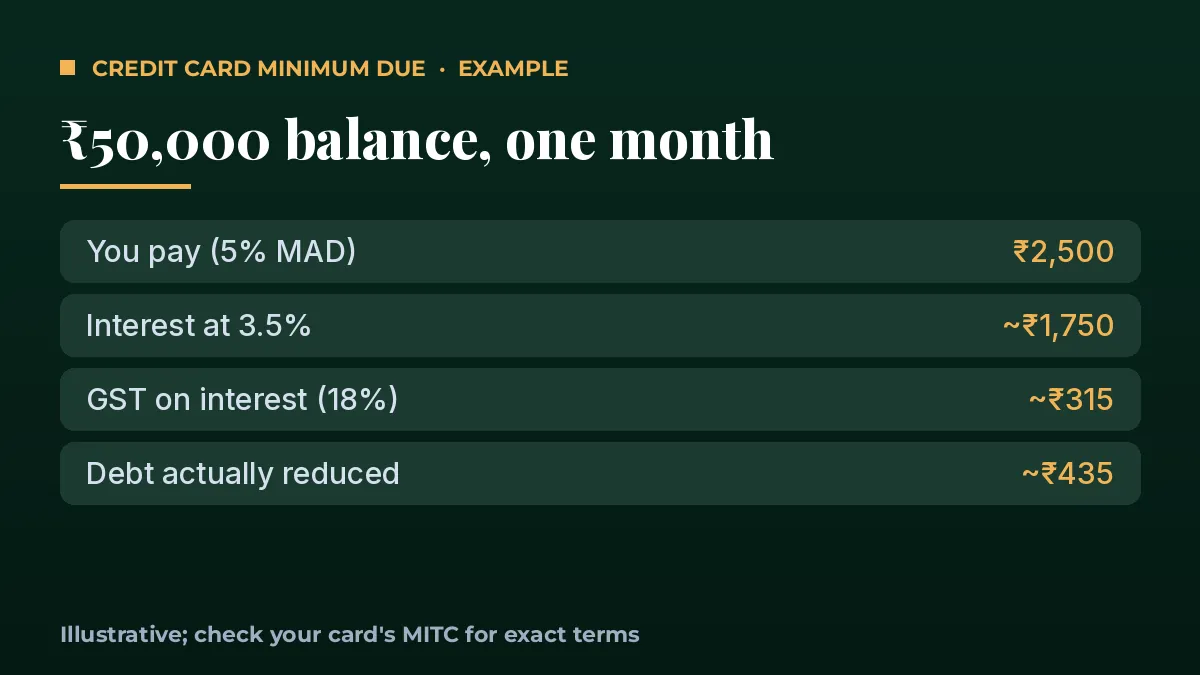
Here is an illustrative case. The numbers are rounded and assume a 3.5% monthly rate with interest on the full balance. Your bank’s exact method may differ.
| Item | Amount |
|---|---|
| Statement balance | ₹50,000 |
| Minimum amount due (5%) | ₹2,500 |
| Interest for one month (3.5% on ₹50,000) | about ₹1,750 |
| GST on interest (18%) | about ₹315 |
| Cost of carrying the balance for one month | about ₹2,065 |
Notice what happens. You pay ₹2,500, but about ₹2,065 goes to interest and tax. Only around ₹435 reduces the actual debt. At that pace, and with any new spending, clearing ₹50,000 can take years. That is the minimum due trap in one table.
What RBI Rules Say About Your Credit Card Bill
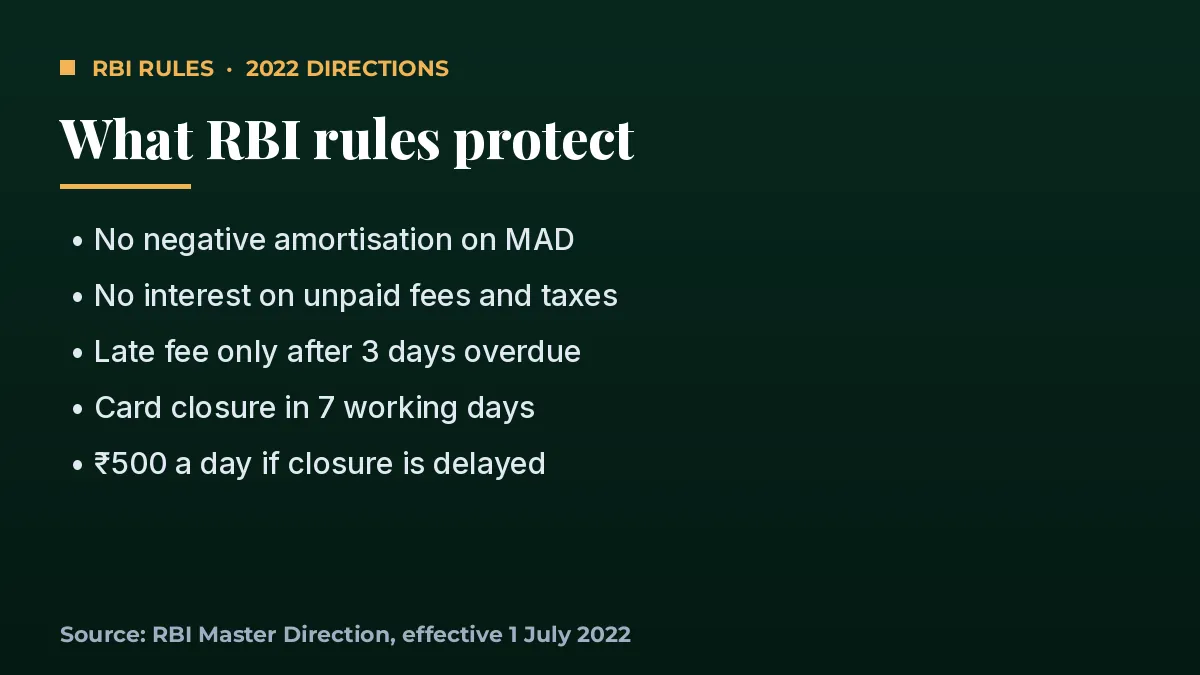
The RBI’s Master Direction on Credit Card and Debit Card (Issuance and Conduct) Directions, 2022, which took effect on 1 July 2022, sets several rules that protect cardholders:
- No negative amortisation: the minimum amount due must be set so that the debt does not keep growing if you pay it.
- No interest on unpaid charges: unpaid fees, levies and taxes cannot be capitalised to charge or compound interest.
- Late fees only after three days: late payment charges and reporting as “past due” apply only when payment is overdue for more than three days after the due date.
- Billing-cycle choice: you can ask to change your billing cycle at least once.
- Closing the card: a closure request must be processed within seven working days if dues are cleared. Otherwise, the issuer must pay you ₹500 per calendar day of delay.
These rules help, but they do not lower the interest rate. The only reliable protection from high interest is to pay the total amount due.
How the Minimum Due Affects Your Credit Score
Paying the credit card minimum due on time does count as an on-time payment. So it will not damage your repayment history the way a missed payment would.
However, a carried balance keeps your credit utilisation high. Utilisation is the share of your card limit that you are using. Lenders and credit bureaus generally view low utilisation more favourably. If your ₹1 lakh limit carries a ₹60,000 balance month after month, your score may suffer even without a single late payment.
For a deeper look at score factors, read our guides on what a credit score is and how to improve it and practical steps to raise your score.
How to Get Out of the Minimum Due Trap: 5 Steps
- Stop new spending on the card. Every new purchase attracts interest while a balance is carried. Switch to UPI or a debit card until the debt is cleared.
- List every card and its rate. Write down the balance, monthly rate and due date for each card. Attack the highest-rate balance first, while paying the minimum on the others.
- Convert to an EMI or a cheaper loan. Many banks let you convert a large balance into an EMI at a lower rate. A personal loan at a lower rate can also replace card debt. Compare the processing fee and total cost before you switch.
- Pay more than the minimum, every month. Even an extra ₹3,000 to ₹5,000 can cut months off repayment, because it goes straight to principal.
- Build a small buffer. Most people fall into revolving credit because of an unplanned expense. A starter emergency fund stops the cycle from repeating.
If your card debt is part of a larger EMI burden, our guide to the ideal debt-to-income ratio can help you set limits. Our emergency fund blueprint shows how to build that buffer.
Five Insights to Remember
- The minimum due is a floor, not a target. It avoids late fees, but not interest.
- Revolving removes your interest-free period. New spends start costing money at once.
- GST adds 18% to the interest. The real cost is higher than the quoted rate.
- Utilisation matters for your score. A carried balance can hurt it even with on-time payments.
- Cheaper debt beats card debt. An EMI conversion or lower-rate loan can save a large amount.
What Happens Next
Credit card use in India keeps rising with UPI-linked cards and easy online approvals. That makes understanding the credit card minimum due more important than ever. Read your MITC, set an auto-debit for the total amount due, and treat revolving credit as an emergency tool only.
Frequently Asked Questions
Is paying the credit card minimum due bad?
Paying the minimum due is better than missing a payment, because it avoids late fees and keeps your record on time. But it is costly as a habit. Interest is charged on the full outstanding amount, new purchases lose the interest-free period, and 18% GST applies to the interest charged.
Does paying the minimum due affect my CIBIL score?
Paying at least the minimum by the due date counts as an on-time payment, so it does not create a late-payment record. However, a balance carried month after month keeps credit utilisation high, which can lower your score over time. Paying the full bill is best.
How is minimum amount due calculated?
It is usually a small percentage of the outstanding balance plus any EMIs, fees and over-limit amount. Each bank sets its own formula in the card’s MITC. RBI rules require that paying the minimum must not lead to negative amortisation, meaning the debt should not grow.
What happens if I pay less than the minimum due?
If the payment is overdue by more than three days after the due date, the bank can levy late payment charges and report the account as past due to credit bureaus. Interest also continues on the full balance. Repeated shortfalls can seriously damage your credit history.
Is there a cap on credit card interest in India?
No fixed cap applies now. In December 2024, the Supreme Court set aside a consumer commission ruling that had limited credit card interest to 30% a year. Banks must disclose rates clearly under RBI rules, so check your card’s MITC.
Sources
- RBI Master Direction: Credit Card and Debit Card – Issuance and Conduct Directions, 2022
- RBI FAQs for the common person
- RBI Complaint Management System (for unresolved disputes)
Disclaimer: This article is for general education and is not financial advice. Interest rates and terms differ by card; check your issuer’s MITC before deciding.