
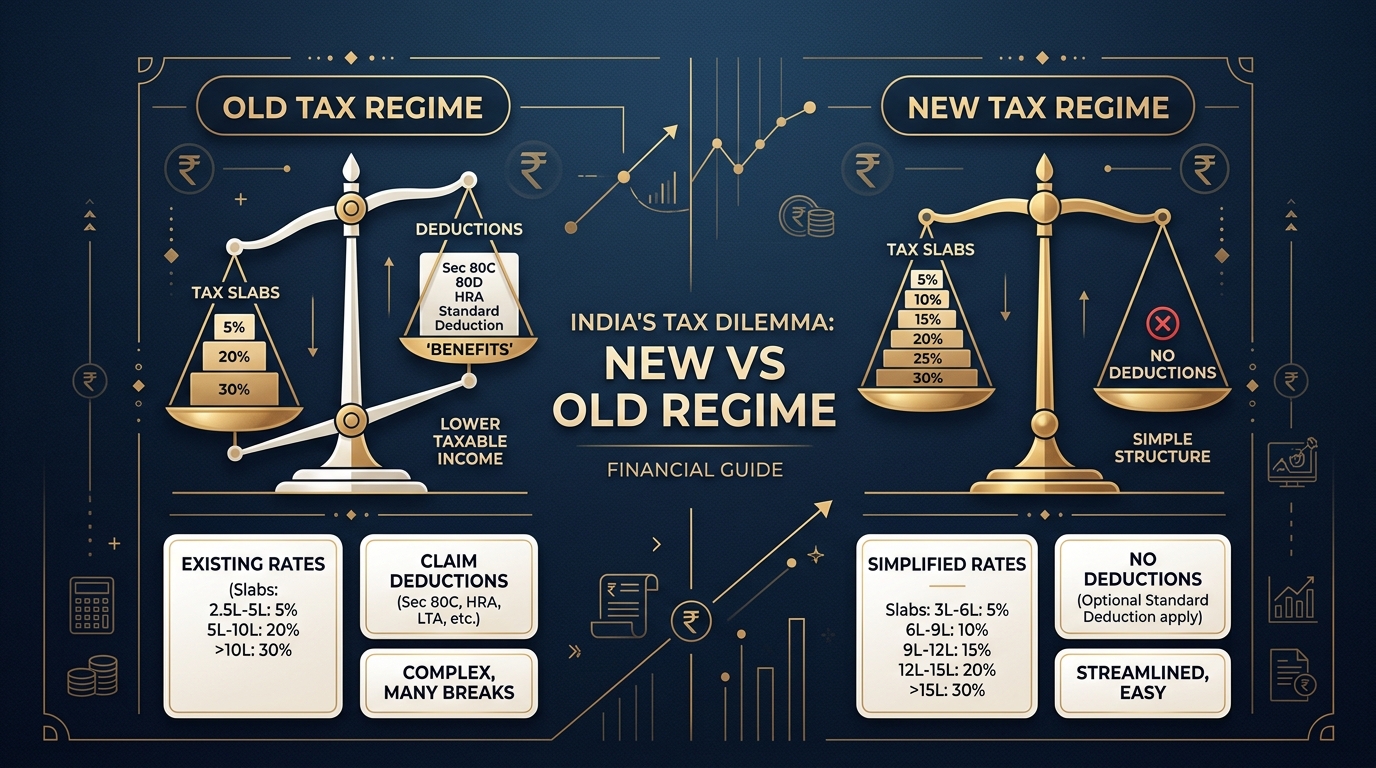
Choosing between the New Tax Regime (governed by Section 115BAC of the Income-tax Act) and the traditional Old Tax Regime represents one of the most consequential personal finance decisions for Indian taxpayers each financial year. With the Central Government progressively positioning the New Tax Regime as the default pathway—sweetened by an enhanced standard deduction of ₹75,000 for salaried individuals and widened concessional tax slabs—evaluating your net tax liability requires precise mathematical calculation rather than intuitive guesswork.
While the New Tax Regime delivers lower marginal slab rates and frees individuals from the annual administrative burden of compiling investment proofs, it completely forfeits major tax-saving exemptions. High-deduction earners leveraging substantial House Rent Allowance (HRA), home loan interest under Section 24(b), and Section 80C instruments often discover that the Old Regime preserves thousands of rupees in disposable income. This comprehensive guide details the structural differences, provides slab-by-slab mathematical comparisons, calculates exact break-even deduction thresholds across income tiers, and presents an actionable roadmap for salaried professionals and self-employed consultants for Assessment Year 2026-27 (Financial Year 2026-27).
Tax Slab Comparison: New vs Old Tax Regime (FY 2026-27)
To grasp the fundamental divergence between both systems, compare the baseline tax slab structures before applying surcharges, deductions, or educational cesses:
| Taxable Income Bracket (₹) | New Tax Regime (Sec 115BAC) | Old Tax Regime (General Individuals <60 Yrs) |
|---|---|---|
| ₹0 to ₹2,50,000 | Nil (Exempt up to ₹3,00,000) | Nil |
| ₹2,50,001 to ₹3,00,000 | Nil | 5% |
| ₹3,00,001 to ₹5,00,000 | 5% | 5% |
| ₹5,00,001 to ₹6,00,000 | 5% | 20% |
| ₹6,00,001 to ₹7,00,000 | 10% | 20% |
| ₹7,00,001 to ₹9,00,000 | 10% | 20% |
| ₹9,00,001 to ₹10,00,000 | 15% | 20% |
| ₹10,00,001 to ₹12,00,000 | 15% | 30% |
| ₹12,00,001 to ₹15,00,000 | 20% | 30% |
| Above ₹15,00,000 | 30% | 30% |
Note: A Health and Education Cess of 4% applies uniformly on top of the calculated aggregate income tax across both regimes. Surcharges apply on taxable incomes surpassing ₹50,00,000.
Section 87A Tax Rebate: Zero Tax Thresholds Explained
The headline feature driving widespread adoption of the New Tax Regime is the aggressive application of the tax rebate under Section 87A:
- New Tax Regime: Provides a full tax rebate of up to ₹25,000 if total taxable income does not exceed ₹7,00,000. When combined with the salaried standard deduction of ₹75,000, salaried employees earning an annual gross salary of up to ₹7,75,000 pay exactly ZERO tax. Marginal relief also prevents punitive taxation for earnings marginally exceeding ₹7,00,000.
- Old Tax Regime: Limits the Section 87A rebate to a maximum of ₹12,500 for taxable incomes up to ₹5,00,000. With the standard deduction of ₹50,000 under the Old Regime, the zero-tax ceiling stands at ₹5,50,000.
Major Deductions & Exemptions: What Stays vs What Is Forfeited
The critical trade-off in opting for lower slab rates under Section 115BAC is the statutory surrender of over 70 popular itemized exemptions and deductions:
1. Forfeited Deductions under New Tax Regime
- Section 80C (up to ₹1,50,000): Investments in Public Provident Fund (PPF), Employee Provident Fund (EPF), National Savings Certificates (NSC), Equity Linked Savings Schemes (ELSS), Life Insurance premiums, and children’s school tuition fees cannot be claimed.
- Section 80D (Health Insurance): Premiums paid for medical insurance covering self, spouse, dependent children, and parents (up to ₹75,000–₹1,00,000 total) are disallowed.
- House Rent Allowance (HRA – Section 10(13A)): Actual rent paid deductions against salary components are completely ineligible.
- Leave Travel Concession (LTC – Section 10(5)): Travel reimbursement exemptions are disallowed.
- Section 24(b) (Home Loan Interest on Self-Occupied Property): Interest deductions of up to ₹2,00,000 on home mortgages cannot be offset against salary income.
- Section 80E & 80TTA: Higher education loan interest and savings account interest exemptions are unavailable.
2. Permissible Deductions Retained under New Tax Regime
- Salaried Standard Deduction: Increased to ₹75,000 (compared to ₹50,000 in the Old Regime).
- Employer NPS Contribution (Section 80CCD(2)): Corporate contributions towards an employee’s National Pension System account up to 14% of Basic + DA (central/state govt) or 10%–14% for private sector employees.
- Transport Allowance for Divyang Employees: Specific disability mobility benefits remain protected.
- Family Pension Standard Deduction: Up to ₹25,000 or one-third of the pension, whichever is lower.
The Mathematical Break-Even Analysis Across Income Levels
To determine which regime saves more money, calculate your Break-Even Deduction Threshold. This is the minimum total dollar value of deductions (HRA + 80C + 80D + 24(b)) you must legitimately claim in the Old Regime to match the tax outflow of the New Regime. If your verifiable deductions exceed this number, the Old Regime wins; if your deductions fall short, the New Regime is financially superior.
| Gross Salary (₹) | Tax Payable in New Regime (₹) | Break-Even Deduction Required in Old Regime (₹) | Recommended Decision Scenario |
|---|---|---|---|
| ₹7,50,000 | ₹0 (Sec 87A Rebate) | ₹2,50,000 | New Regime (Guaranteed ₹0 tax with zero lock-in) |
| ₹10,00,000 | ₹46,800 | ₹3,00,000 | New Regime for most; Old Regime only if max HRA + 80C claimed |
| ₹12,50,000 | ₹88,400 | ₹3,41,667 | Balanced Zone: Calculate precise rent receipts |
| ₹15,00,000 | ₹1,35,200 | ₹3,75,000 | Old Regime wins if claiming HRA (₹1.5L) + 80C (₹1.5L) + 80D (₹25k) + 24(b) (₹1L) |
| ₹20,00,000 | ₹2,86,000 | ₹4,25,000 | Old Regime strongly favorable for homeowners with active mortgages |
| ₹25,00,000 | ₹4,42,000 | ₹4,50,000 | Requires substantial deductions (Home Loan + HRA + NPS) to beat New Regime |
Note: Figures incorporate applicable 4% Health & Education Cess. The standard deduction difference (₹75,000 New vs ₹50,000 Old) is accounted for in all calculations.
Case Study: Rahul (Gross Salary ₹15,00,000)
To demonstrate the real-world calculation, consider Rahul, a 32-year-old software engineer living in Bengaluru with an annual gross salary of ₹15,00,000:
Scenario A: Choosing the New Tax Regime
- Gross Salary: ₹15,00,000
- Less Standard Deduction: ₹75,000
- Net Taxable Income: ₹14,25,000
- Tax on ₹0 to ₹3,00,000: ₹0
- Tax on ₹3,00,001 to ₹7,00,000 @ 5%: ₹20,000
- Tax on ₹7,00,001 to ₹10,00,000 @ 10%: ₹30,000
- Tax on ₹10,00,001 to ₹12,00,000 @ 15%: ₹30,000
- Tax on ₹12,00,001 to ₹14,25,000 @ 20%: ₹45,000
- Base Income Tax: ₹1,25,000
- Add 4% Cess: ₹5,000
- Total Tax Liability: ₹1,30,000
Scenario B: Choosing the Old Tax Regime
Rahul pays monthly rent of ₹25,000 (claiming eligible HRA of ₹1,80,000), invests ₹1,50,000 in EPF/PPF under Section 80C, pays ₹25,000 for health insurance under Section 80D, and has standard deduction of ₹50,000:
- Gross Salary: ₹15,00,000
- Total Deductions: ₹50,000 (Std Ded) + ₹1,80,000 (HRA) + ₹1,50,000 (80C) + ₹25,000 (80D) = ₹4,05,000
- Net Taxable Income: ₹10,95,000
- Tax on ₹0 to ₹2,50,000: ₹0
- Tax on ₹2,50,001 to ₹5,00,000 @ 5%: ₹12,500
- Tax on ₹5,00,001 to ₹10,00,000 @ 20%: ₹1,00,000
- Tax on ₹10,00,001 to ₹10,95,000 @ 30%: ₹28,500
- Base Income Tax: ₹1,41,000
- Add 4% Cess: ₹5,640
- Total Tax Liability: ₹1,46,640
Outcome: Despite claiming ₹4,05,000 in heavy deductions, Rahul saves ₹16,640 by opting for the New Tax Regime! This highlights how aggressively the New Regime’s widened slabs compress liability for middle-income earners.
Who Should Pick Which Regime? A Strategic Framework
When finalizing your tax declaration with your employer or preparing for your income tax return filing, follow this decision rubric:
Opt for the NEW Tax Regime if:
- Your total gross income is up to ₹7,75,000 (Zero tax via Section 87A rebate and standard deduction).
- You do not pay rent or live in your own paid-off parental home (no HRA exemption).
- You do not have an active home loan on a self-occupied property.
- You prioritize higher liquidity and flexibility to invest freely in equity or mutual funds without being forced into lock-in instruments like 5-year tax-saving FDs or traditional life insurance policies.
- Your total legitimate deductions across 80C, 80D, HRA, and home loan interest fall below the break-even threshold for your income bracket.
Opt for the OLD Tax Regime if:
- You service an active home loan where interest under Section 24(b) exceeds ₹1,50,000 annually.
- You pay substantial house rent in a metro city and receive structured HRA from your employer.
- You maximize Section 80C (₹1.5L) through mandatory EPF or PPF, combined with senior citizen parents’ medical coverage under Section 80D (up to ₹50,000).
- Your total cumulative deductions exceed ₹3,75,000 to ₹4,25,000 at a gross salary of ₹15,00,000 or above.
Procedural Rules: Can You Switch Between Regimes?
The Income Tax Department enforces specific switching rules depending on your primary source of income:
- Salaried Individuals (Without Business Income): You enjoy complete flexibility to switch between the New and Old Tax Regimes each financial year. You can declare your preferred regime to your employer at the beginning of the fiscal year for TDS deduction, and you can even switch your choice at the time of filing your final Income Tax Return (ITR-1 or ITR-2) under Section 139(1).
- Professionals & Business Owners (ITR-3 or ITR-4): Individuals with income from business or profession can opt out of the default New Tax Regime only once by filing Form 10-IEA prior to the ITR filing due date. Once you opt out and revert to the Old Regime, you can switch back to the New Regime only once in a lifetime, after which you are permanently locked into the New Regime.
Impact on Financial Planning & Long-Term Wealth Creation
One unintended benefit of the New Tax Regime is the decoupling of tax savings from investment decisions. Historically, millions of Indian professionals purchased suboptimal endowment insurance policies or locked capital into low-yielding products simply to exhaust the ₹1.5 lakh Section 80C ceiling before March 31. Under the New Regime, you can redirect your surplus capital based on genuine risk-adjusted financial goals, such as deploying disciplined monthly contributions into equity index funds or utilizing systematic investment plans.
For investors planning long-term wealth milestones, evaluating your post-tax asset allocation alongside our interactive tools provides essential clarity. Explore our dedicated Inflation Calculator to see how long-term purchasing power behaves, visit the Tax Category Hub for updated compliance guidelines, or review our detailed comparative analysis on Small Savings Rates & PPF Returns to balance debt allocations effectively.
Frequently Asked Questions (FAQ)
Is the New Tax Regime mandatory for all Indian taxpayers?
No. While the New Tax Regime is the default regime in the income tax filing utility, it is not mandatory. Every individual taxpayer has the legal right to opt for the Old Tax Regime if it offers lower aggregate tax liability.
Can I choose the Old Regime during ITR filing if my employer deducted TDS under the New Regime?
Yes. Salaried employees can freely switch between the New and Old Regimes when filing their annual return on the e-filing portal before the July 31 deadline, irrespective of what was declared to their HR or payroll department.
What is the standard deduction amount under the New Tax Regime?
The standard deduction for salaried individuals and pensioners under the New Tax Regime is ₹75,000. Under the Old Tax Regime, it remains ₹50,000.
Does home loan principal repayment qualify for deduction under the New Tax Regime?
No. Home loan principal repayment under Section 80C is disallowed under the New Tax Regime. Only the interest deduction on let-out properties (subject to standard loss restrictions) is partially recognized.
Important Disclaimer: The content on FinanceWithPrahlad.com is strictly for financial literacy and educational purposes. Prahlad Kumarr and this website are NOT SEBI-registered investment advisors or research analysts. Mutual fund investments and securities are subject to market risks. Please consult a qualified SEBI-registered financial advisor before making any financial or investment decisions.