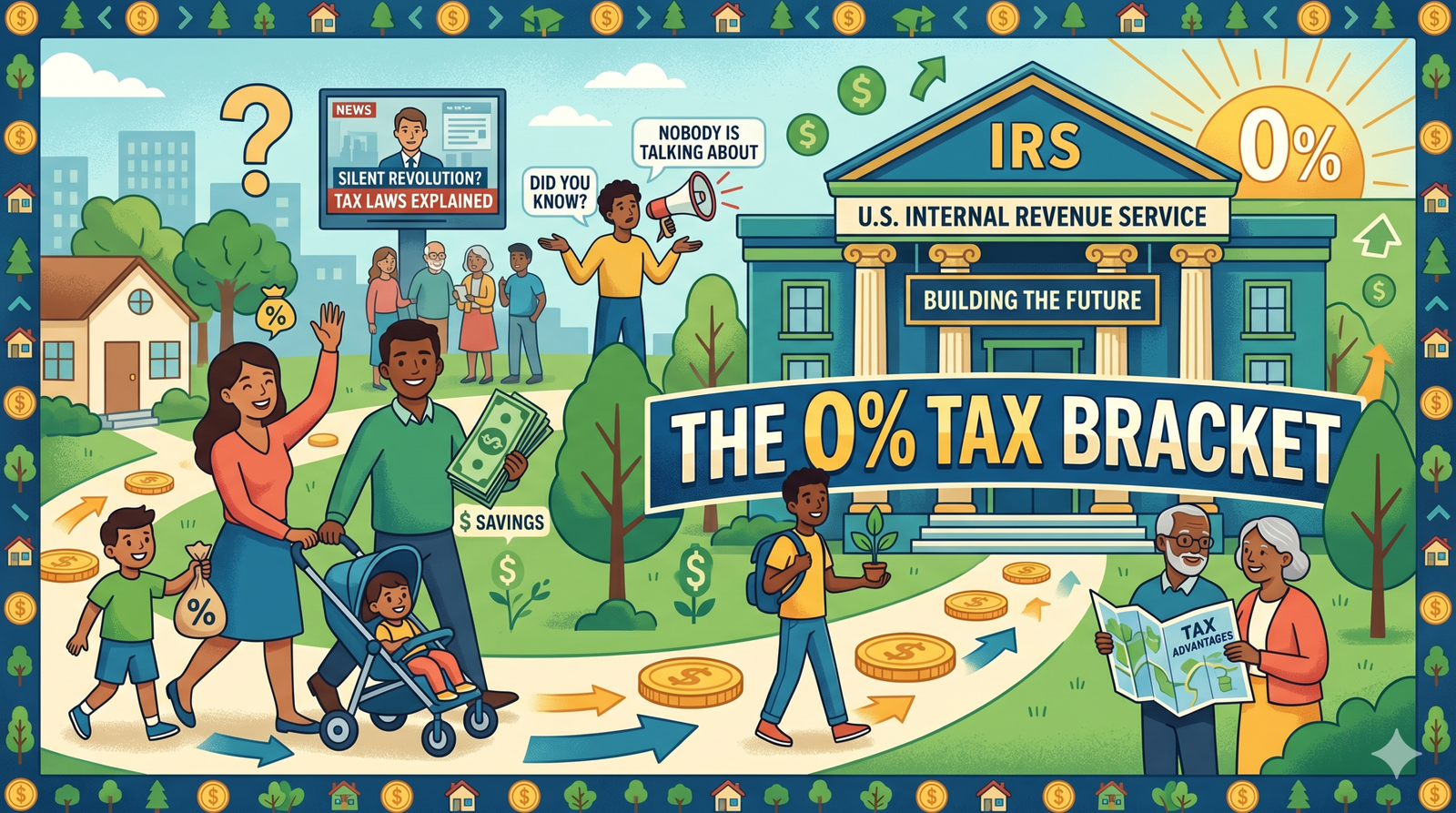
The IRS tax code contains a published 0% long-term capital gains rate available to millions of Americans in 2026. Learn exactly who qualifies, how the five-step gain harvesting strategy works, and how to legally eliminate thousands in future capital gains taxes before December 31.
You Have Been Paying a Tax You Were Never Legally Required to Pay
You have been investing consistently for years. Index funds. A taxable brokerage account at Fidelity or Vanguard or Schwab. The balance has grown. And somewhere in the back of your mind you carry a quiet assumption — when I eventually sell, I will pay taxes on those gains.
That assumption feels responsible. It feels like the correct mindset for a patient, long-term investor.
According to the Joint Committee on Taxation’s 2023 revenue analysis, that assumption cost qualifying American households $9.4 billion in capital gains taxes they were legally not required to pay. Not because the IRS deceived them. Because nobody told them that a 0% long-term capital gains bracket exists — and that 28 million US households qualify for it in any given year.
The TIAA Institute’s 2025 financial literacy index found that only 13% of American adults correctly identify that long-term capital gains are taxed at a different and lower rate than ordinary income. That means 87 out of 100 Americans are making investment decisions based on a fundamentally false understanding of how their gains are taxed.
This article explains exactly what the 0% bracket is, who qualifies, how to use it, and why the financial industry has never had a reason to show it to you.
Watch the full video for the complete breakdown.
What the 0% Capital Gains Bracket Actually Is — And Who Qualifies in 2026
Long-term capital gains — profits on investments held more than one year — are taxed on a separate rate schedule from ordinary income. In 2026 that schedule has three tiers. The 0% rate applies to taxable income up to $49,450 for single filers and $98,900 for married couples filing jointly. The IRS confirmed these thresholds in Revenue Procedure 2025-40, independently verified by the Tax Foundation.
**The critical word is taxable income — not gross income.** After the 2026 standard deduction of $16,100 for single filers and $32,200 for married couples, most middle-income households have significantly less taxable income than their W-2 suggests.
A single teacher earning $52,000 has taxable income of approximately $35,900 after the standard deduction — giving her $13,550 of 0% capital gains harvesting room. A married couple earning $85,000 combined has taxable income of roughly $52,800 — giving them over $46,000 of gains they can harvest completely tax free in 2026.
The One Big Beautiful Bill Act, signed July 4, 2025, permanently indexed the 0% bracket to inflation — removing the political risk that previously existed around this provision. This is the most stable, predictable window to build a multi-year gain harvesting strategy that has ever existed in US tax history.
The Nobel Prize-Winning Research That Explains Why 28 Million Americans Never Use This Bracket
The reason 28 million qualifying households leave this bracket completely unused every year is not ignorance alone. It is a documented cognitive mechanism called status quo bias — named and documented by William Samuelson and Richard Zeckhauser in the Journal of Risk and Uncertainty in 1988 and later extended into financial behavior by Nobel Prize winner Richard Thaler.
Status quo bias causes human beings to treat inaction as the safe default — even when action is mathematically superior, legally costless, and permanently beneficial. For investors, the status quo is hold. Never sell. Let it compound. That instinct built your account. It is also the reason you leave the 0% bracket completely unused year after year.
The second mechanism is tax anxiety. The word taxes triggers avoidance. Most people do not engage with their brokerage accounts because they fear generating a tax event. **That protective instinct — the one that feels like financial responsibility — is the exact mechanism preventing you from discovering that the tax event in the right year costs you nothing.**
There is also a structural reason the financial industry never corrects this. The clients who most benefit from 0% bracket harvesting earn between $40,000 and $75,000 per year — precisely the clients financial advisors cannot profitably serve at a 1% AUM fee on a $50,000 account. Vanguard’s 2022 Advisor’s Alpha research quantified the tax planning value at 0.7% annually, but that value only reaches you if someone explains the strategy. The middle-income investor is structurally left out — not through malice, but through economics.
The Five-Step Gain Harvesting Strategy — Completely Legal, Almost Nobody Discusses It
Gain harvesting is the legal, rational inverse of tax-loss harvesting. It works as follows.
1. Calculate your estimated 2026 taxable income before December 31. Use your most recent pay stub. Subtract the standard deduction — $16,100 single, $32,200 married.
2. Compare that number to $49,450 single or $98,900 married filing jointly.
3. The gap between your taxable income and the threshold is your 0% harvesting room.
4. Log into your taxable brokerage at Fidelity, Vanguard, Schwab, or Robinhood. Identify your most appreciated position. Sell shares up to your harvesting room amount in gains.
5. Immediately repurchase the same shares at the new higher price.
That final step is the one that stops most people. It sounds too clean. Here is why it is completely legal. The wash sale rule — the IRS provision preventing you from selling a loss and immediately rebuying — applies only to losses. IRS Publication 550, updated in 2025, is explicit on this point. The wash sale rule does not apply to gains. You can sell VTI, pay zero federal tax because your income qualifies, and immediately repurchase VTI at the new higher cost basis — permanently eliminating that gain from your future tax liability.
Ivković, Poterba, and Weisbenner published the return data in the Journal of Finance in 2005. Tax-aware portfolio management — specifically harvesting gains during qualifying years — improves after-tax returns by 0.5% to 1.1% annually for middle-income households. On a $150,000 portfolio over 30 years, that 0.5% improvement adds $87,000 in terminal wealth. Not from better stock picks. Not from market timing. From knowing which year to sell.
# The Actively Managed Fund Problem Nobody Talks About
There is a hidden threat to your 0% bracket that operates silently inside your taxable brokerage account. When a fund manager inside an actively managed mutual fund sells a position, every shareholder in that fund receives a capital gains distribution — whether you sold a single share or not.
Morningstar’s 2023 analysis found the average actively managed equity fund distributed 6.2% of NAV as capital gains to taxable account holders. On a $100,000 position that is $6,200 in forced taxable gains consuming $6,200 of your 0% bracket room every year — automatically, silently, regardless of any decision you made.
**VTI on Vanguard, FXAIX on Fidelity, and SWTSX on Schwab generate near-zero capital gains distributions because their portfolio turnover is minimal.** Switching from an actively managed fund to any of these index funds inside your taxable account does two things simultaneously — it stops the involuntary distribution problem and preserves your entire 0% bracket for strategic annual harvesting. The fund you hold and the tax bracket you use are the same decision. Almost no one connects these two facts.
# Your Action Plan by Income Level — Executable Before December 31
The most valuable financial action you can take today requires no additional capital, no financial advisor, and no tax software upgrade. It requires twenty minutes and one number.
Pull your most recent pay stub. Estimate your 2026 W-2 income. Subtract the standard deduction. Compare the result to $49,450 single or $98,900 married. That gap is your 0% harvesting room. Write it down.
If you earn $50,000 as a single filer your taxable income after deductions is approximately $33,900 — giving you $15,550 of 0% harvesting room. Log into your taxable brokerage before December 31. Find your most appreciated position. Sell up to $15,550 in gains. Immediately repurchase. Pay zero federal capital gains tax. If you hold actively managed funds, move them to FXAIX on Fidelity, VTI on Vanguard, or SWTSX on Schwab this week to stop the silent bracket drain permanently.
If you earn $100,000 as a married couple your taxable income after deductions is approximately $67,800 — giving you $31,100 below the married 0% threshold. Use part of that room for gain harvesting in your taxable account. Use part of it for a Roth IRA conversion from your Traditional IRA or old 401(k) in the same tax year. Running both strategies simultaneously is legal and almost completely absent from mainstream financial content. Confirm the specific numbers with TurboTax or a fee-only CPA before executing.
The one number to check is Line 15 on your Form 1040. Your taxable income. Compare it to the threshold. If you are below it, you have harvesting room. Twenty minutes. Zero cost. Do it before December 31.
The IRS did not hide this from you. The financial industry just never had a reason to show it to you.
Watch the full video for the complete breakdown.